Subscribe to Eat Like No One Else Subscribe to Eat Like No One Else's comments

Posts tagged ‘Probe Therometer’

Roasted Chicken with Ramps

Recently I discovered ramps at a local grocery store (Produce Station). They are also called wild leeks and can add an onion/garlic flavor to a dish. Click here to read my post on what ramps are. Ramps go excellent with chicken.

Ingredients
1 whole fryer chicken (make sure to remove whatever is in the cavity, giblets, heart, etc.)
1 bunch of ramps (6-8 ramps)
olive oil
kosher salt
freshly ground black pepper
dried rosemary
dried tarragon
1 1/2 cups chicken broth (to make a sauce)

* NOTE * Get all your ingredients ready ahead of time so that there isn’t an cross-contamination. The last thing I want is for you to touch the chicken and then touch your containers of herbs to get them out for this recipe. Put everything you need in small bowls before you even touch your chicken and make sure to wash your hands before you touch anything else in your kitchen.

Preheat your oven to 350 degrees. Take your ramps and cut off the leaves, leaving the pink stem attached to the bulbs. Save the leaves for later use. Take the bulbs and drizzle some olive oil over them, then sprinkle kosher salt and black pepper over them.

Now place your chicken on a roasting pan. Using a pairing knife or kitchen shears, pull back the skin without removing it, over the breasts, thighs, and drumstick areas of the chicken. Place the ramps under the skin in these areas. Sprinkle some dried rosemary and tarragon over these same areas and the entire chicken.

Insert a probe thermometer into the breast on an angle, being careful not to hit any bone. Cook the chicken until the temperature reaches 165 degrees. The dark meat should be at 180, so make sure to check that too, and if the dark meat is not ready, put foil over the breast and cook until the dark meat hits 180.

Now to prepare the sauce. Take your roasting pan and place it over 2 burners. Add 1 1/2 cups of chicken broth. Scrap all the bits you can off the bottom of the pan and bring to a boil. Add the leaves from your ramps and cook for 2 minutes, then remove them. Simmer the sauce until it has been reduced to your desired thickness. Keep in mind that the more water that you lose, the more salty the sauce will be, so since my wife does not like things too salt and keep the sauce pretty thin.

Roasted Chicken

Looking to save money on your grocery bill? Buy whole chickens. They can be had for much cheaper a pound than any chicken that has been sliced up for your convience. I like to roast the entire chicken, eat it that night, and save the leftovers to use in other dishes the next day or two. I buy what is called a fryer chicken, which is a young chicken (between 7-13 weeks old) that weight about 1 1/2 to 4 pounds. Before you roast your chicken, you should add some additional flavor. I do this with ”a paste”. For the paste you will need:

4-5 gloves of garlic
The herbs of your choosing (rosemary, basil, tarragon, thyme are all good choices)
Olive oil or canola oil
kosher salt
freshly ground black pepper

Take your garlic and just give it a good smashing, no need to cut it into small pieces. Throw the garlic into a bowl, along with your herbs, a heavy pinch of kosher salt, several grinds of freshly ground black pepper, and a couple tablespoons of oil. Mix well to combine (if you are doing a larger chicken, you might want to make your paste in a food processor). You don’t need to perfectly measure everything here.

The first thing you need to do with the chicken itself is to remove anything in the cavity, giblets, heart, and neck. Once that is done, take your chicken and pull back the skin (do not remove it) in any places you can get it to go (you can use a knife to help you). Then rub your paste in between the meat and skin. Do this in as many spots as possible. Make more paste if you need to. Remember to wash your hands immediately after touching the raw chicken. Do not touch anything else before you wash your hands. Cross contamination is a major concern with chicken.

Set your oven to 350 degrees. Once your chicken is prepared set it in a roasting pan and insert a probe thermometer into the thickest part of the chicken, being careful not to hit any bone, and roast until the thermometer says 165 degrees and the juices run clear. There is a fine line between perfectly done chicken and dried out chicken. But if you under cook it that’s bad news too. So it may take some practice, but I always recommend that if you don’t feel comfortable pulling the chicken yet, then wait a little bit longer.

If you plan on eating the skin of the chicken, I would recommend starting the chicken at 450 degrees for 10-15 minutes, then reduce it to 350 until the chicken has reached it’s final temperature. You may also wish to flavor the skin, by sprinkling kosher salt, black pepper, and maybe some paprika on the outside before cooking.

Now it’s time to slice up the bird and enjoy! I recommend eating first the parts of the chicken that was closet to the areas in which you inserted your paste. If you have any leftovers and are planning to use them in other ways, it’s better to use the chicken that didn’t get as much seasoning the first time around.

Now speaking of other recipes for leftover chicken, here are a couple I did the last time I roasted a chicken:
Chicken Faijtas (in an electric skillet)
One-Serving Chicken Noodle Soup

Alton Brown City Ham

This is a recipe review, which means this is a recipe that I did not personally come up with, but that I tried out and am giving my opinion on how the recipe turned out. For legal reasons I cannot post these recipes, but I can tell you where you can get them yourself.

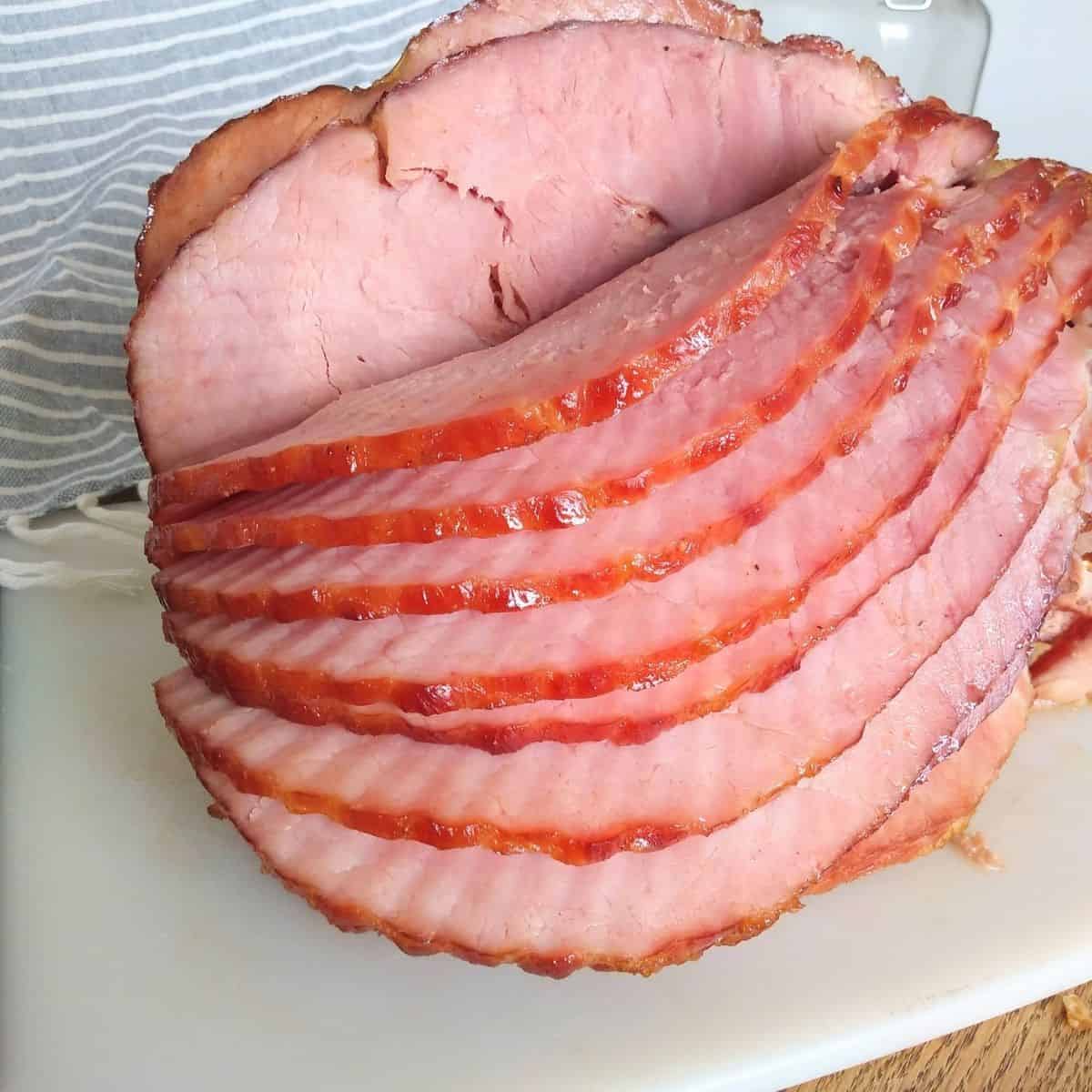
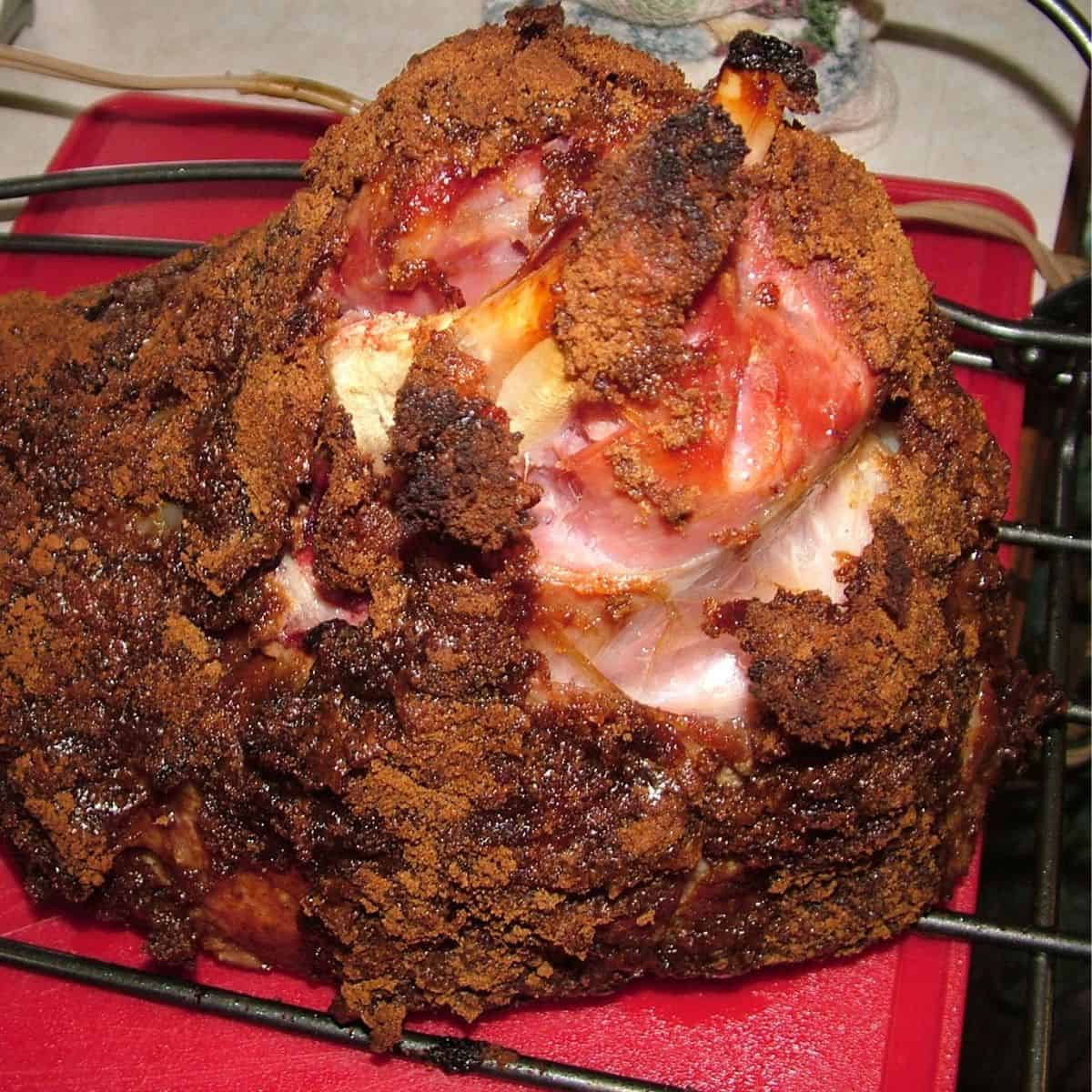
Yesterday for my Easter dinner I gave Alton Brown’s recipe for city ham a try. In case you don’t know what a city ham is, check out my post on the different types of ham. This recipe has you applying a crust to that ham that is made up of dark brown sugar, brown mustard, and ginger snap cookies. Yes I said ginger snap cookies. You turn them into dust in your food processor and apply them to the ham in the final hour of cooking. Here are my notes from making this recipe.

Click here for the recipe.

1. I used a shank end city ham, like Alton picked out in the show.
2. The only ingredient I left out was the bourbon spray. I found that my ginger snap cookies stuck to the ham really well without the need for any additional liquid.
3. The basting brush worked well to get the mustard layer on the ham.
4. I used my probe thermometer to tell when the ham had reached 130 degrees, so I knew when it was time to put on the crust.
5. We carved the ham up using an electric knife, which made the job really easy.

This ham was delicious. My wife wanted to try this recipe because she isn’t really into ham, but like the idea of the crust. The crust came out perfect and she did indeed love it! I didn’t really have any problems with this recipe. It was rather simple and good.

Recipe Grade: A

Click here for the recipe.

The most tender part of the pig – the pork tenderloin. It is a versatile piece of pork than you can grill or roast with a wide varieties of flavors. The flavor we are focusing on today is teriyaki – a salty and sweet combination featuring brown sugar and soy sauce. Pork tenderloin is great for marinating as it’s low fat content can lead to drying out if you overcook it. Using a marinade is one way to introduce flavor and keep your pork moist and tender.

Ingredients

1 whole pork tenderloin

4 tablespoons low sodium soy sauce

2 garlic cloves, minced

2 tablespoons olive or canola oil

2 teaspoons light brown sugar

1 teaspoon freshly ground black pepper

Combine all the ingredients into a large zip top plastic bag. Then place the tenderloin inside. Seal the bag, making sure the marinade is completely covering the meat. Place inside a container large enough to fit that bag (just in case the bag decides to leak) and place in the fridge for about 4-6 hours. Don’t go beyond 8 hours or you might end up with salty pork.

Set your oven to 425 degrees. Take the pork out of the fridge and discard the marinade. Pat the pork dry. Place it on a pan lined with parchment paper or in a roasting pan. Place a probe thermometer on an angle in the center of the tenderloin and cook until the temperature reaches 160 degrees. You can use an instant read and check the temperature if you don’t have a probe variety. If you have neither type it should take around 25-35 minutes to cook, but going by temperature is best. Slice and serve!

TurkeyDrumsticks

When my wife and I were preparing to celebrate our 1st Christmas together, we were looking for someone special to make for dinner on Christmas Eve. After a trip to the grocery store, I came up with turkey drumsticks. We have been making these drumsticks every Christmas Eve for the last 5 years. As I have become a better cook, the drumsticks have become better too. The process begins with a brine that will keep your drumsticks moist and add additional flavor. We normally buy 3 drumsticks so the recipe is based on that. If your drumsticks are frozen, make sure to defrost them first.

Brine
4 cups vegetable broth
1/2 cup kosher salt
1/2 cup light brown sugar
1 tablespoon black peppercorns
1 pound of ice

Place a saucepan with the broth along with the peppercorns over medium heat. Add the sugar and salt to the broth and cook until they are dissolved. Take the pan off the heat and stir in the ice, to bring the temperature down (you don’t want to boil the drumsticks!). Place the drumsticks in a gallon size plastic bag and add the liquid. Place the bag in a dish just in case it leaks and place it into the fridge. Allow the brine at least 2-3 hours to work. I would not go more than 6, or you might end up with some salty turkey.

When it is time to cook take your drumsticks out of the bag and pat them dry. You will now need the following items for additional flavor:

canola oil
fresh rosemary, thyme, and sage

Rub each drumstick with canola oil, just enough to make it shiny. Cut up the herbs and rub them all over the drumsticks. The amount of herbs you will need depends on the size of the drumsticks. While you are doing this you can heat your oven to 500 degrees, we are going to start high in order to get some nice coloring on the outside, then we will turn it down to 350 for the rest of the way.

When your drumsticks and oven are both ready, place them on the center rack of your oven and cook them for about 10-15 minutes (this may produce some smoke in your kitchen, especially if you haven’t cleaned your oven this decade; I would recommend cleaning your oven before doing this recipe). After that time is up, turn the oven down to 350 and insert a probe thermometer into the biggest part of the largest drumstick. Be very careful that you don’t hit a bone or your temp reading will be off. Since drumsticks are dark meat you will want to cook them until they reach a temperature of 180 degrees. I would plan on about 1 to 1 1/2 hours for them to be done, but it depends on how big the drumsticks are and your oven. When you take them out let them rest for 5-10 minutes before cutting into them.

I think the one question that most cooks have whenever they are cooking meat, whether it be chicken, beef, pork, or whatever animal is when is it is done. They open the oven door, poke the meat, stare it trying to determine if it looks done, and then pull the meat 30 minutes after it should have already been out of the oven. So how do one know when their meat is done? Many meats will come in packages that tell you how long to cook it per pound. That might work, if every piece of chicken was shaped exactly the same. So the only other option out there is a thermometer. A thermometer will be able to tell you exactly when your meat is done. There are two types of thermometers I recommend: a probe therommeter and an instant read (both of the digital variety). Both can be had for less than $20 a piece.

A prope therometer is perfect for putting into a roast. All you do is stick the probe end into the hunk of meat, put the meat in the oven, and plug in the therometer. Then you can watch as the temperature rises until it reaches your desires doneness (with roast it’s a good idea to pull it from the oven 5-10 degrees before it’s done because there will be carry-over when you take it out). You have to be careful that you inser the probe into the right spot. If you hit a bone or the bottom of the pan you will get a false reading. It’s best to stick the probe on an angle into the thickest part of the meat.

An instant read therometer will tell you within 5 seconds what the tempearture of your meat is. Why would you need of these as well as a probe? Sometimes a probe therometer can’t be used like when grilling, cooking a piece of meat that is too thin to get the probe in, or when you are braising or cooking in liquid. An instant read can be used to test whether the meat is done in those situations. It can also be used to taste whether a loaf of bread is done.

Here is a list of the temperature you want to cook certain types of meat to (these are all minimum temperatures):

Pork: 160 degrees

Poultry: 165 degrees (for dark meat of a turkey: 180 degrees)

Beef: Medium rare (135 degrees), Medium (145 degrees), Medium Well (155 degrees), Well Done (or Toast) (160 degrees)

Lamb: 160 degrees

Fish: 145 degrees

Pork Roast Sliced

Click here to ready other posts on the topic of pork.

If you are looking for a good and cheap pork roast, give the sirloin roast a try. I has gotten it on sale for under $2 a pound. The sirloin roast comes from the loin area of the pig. The loin is divided into 3 sections, the blade, the center, and the sirloin. The sirloin is the area close to the back of the pig. It has less fat than the blade, but it not as tender as the center. The roast can dry out easily if you are not careful. It can be nice and juicy if you follow my simple instructions below.

Instructions

In order to make this a juicy roast, it best to soak it in a brine before you cook it. A brine will bring flavor to the inside of the meat via the process of osmosis. This brine is based on a brine Alton Brown used for slow cooked pork chops on an episode of Good Eats.

Ingredients for the Brine

2 cups vegetable broth

1/4 cup kosher salt

1/2 cup light brown sugar

2 tablespoons whole black peppercorns

Combine all the ingredients into a saucepan over high heat. Cook until the salt and sugar are dissolved. Then remove from the heat and add about 1 pound of ice to cool the brine down. Give it a good stir and set it aside. Now take your pork sirloin roast and place it in a gallon sized plastic bag and dump the brine into the bag. Seal the bag well, place it in a container just in case the bag leaks, and place it into the refrigerator for at least 2 hours, 6 if you can. I have found that even 2 hours does make a difference. I have also found that if you leave it too long it becomes too salty for our family.

Once the pork has finished it’s soak, take it out of the bag, lightly rinse off the roast, and pat with a power towel to dry. While you are doing this preheat your oven to 250 degrees. You have added flavor to the inside of the meat, now it’s time to add some to the outside. You will need the following for the crust.

Ingredients for Herb Crust

your choice of a combination of fresh or dried thyme, rosemary, and/or tarragon

canola oil

kosher salt

Rub down the roast with a bit of canola oil, just enough to make it a little shiny. Then sprinkle kosher salt all over the roast. Then add your herb combo to all sides of the roast (the amount you use depends on the size and shape of the roast). Place the roast on a roasting pan with the side with the most fat up (and this is a leaner cut so there won’t be too much fat). Then insert a probe therometer on an angle through the center of the meat (this is really the only way to know for sure when your roast is done). Place into the oven.

You want your roast to be cooked between 160-165. So when the roast hits about 130-135 pull it from the oven and cover it with foil. Then turn the oven up to 500 degrees (this will give it a nice flavorful crust). The roast will rise about 10 degrees while your oven is moving up in temperature. When the oven is ready, remove the foil and return the roast to the heat. When it hits about 150-155 pull the roast from the oven. Cover with foil again and let it rest for about 10 mins and the temperature should be between 160-165 when that time is up. Slice and enjoy!

Pork Sirloin Roast

Click here to ready other posts on the topic of pork.

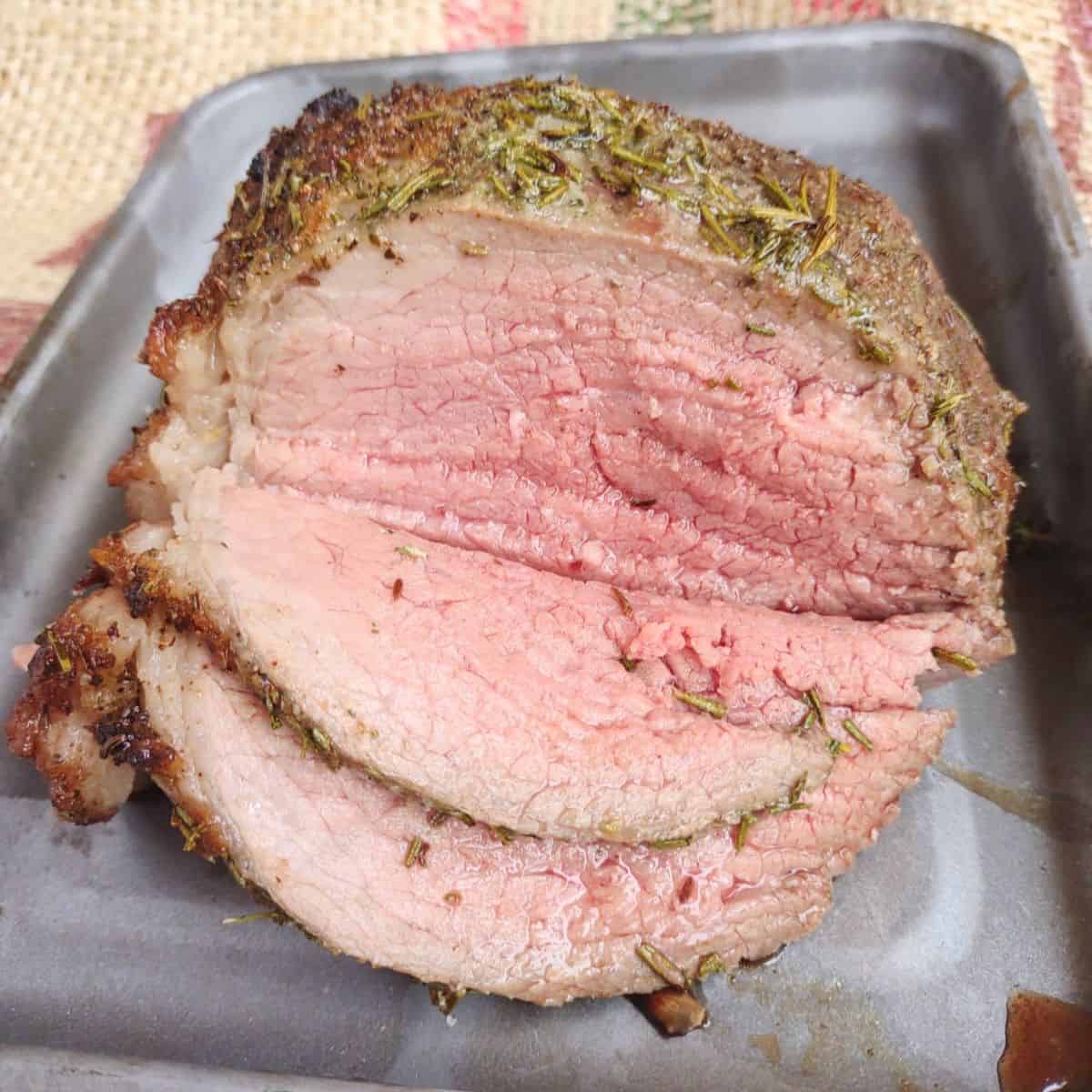
Finished Eye of Round

If you are looking for how to cook an eye of round steak, check out this post.

Last week I found an entire boneless eye of round roast at a local grocery store. So this week, I had to decide what to do with it. But first I needed some more information. What I found is that the eye of round of course comes from the round portion of the cow (yes that’s the backside!). This area also contains the top round and bottom round. The eye of round is a cylinder shaped cut of beef. It is lean in that there is only some fat on the outside and very little marbling on the inside. It is not the most tender piece of meat because that part of the cow does get a workout. So keeping in mind all this knowledge and after cutting my whole eye of round into about a 3-lb roast for that night’s dinner, I came up with the following recipe:

Instructions

Set your oven to 200 degrees. We are going to start low, so that the outside doesn’t become leather before the inside is done. Take your roast and liberally season it with kosher salt. Then to make a flavorful crust, use the following spice rub.

Ingredients for Spice Rub

1 teaspoon coriander seed

1 teaspoon celery seed

1 teaspoon whole cumin seeds

1 teaspoon garlic powder

1/4 teaspoon ground mustard

Place all of these in your spice grinder (coffee grinder) and grind them for 10-15 seconds. (To learn more about using a coffee grinder to grind spices, read this post). Take this spice rub and rub it into the meat, all over the entire roast. If you wish to make more of the rub just keep the portions the same.

How to Cook It

Now that your meat is ready to meet the heat, place it on a roasting pan. Then stick a probe thermometer into the center of the meat on an angle. If you don’t have one it will be hard to determine your roast is done. Some will try to tell you to cook it for 7 minutes per pound but I don’t buy into that, as there is no way those kind of calculations can take into effect the shape of the roast. Now once your thermometer is in place, stick your roast into the pre-heated 200 degree oven. Keep in in there until the temperature is about 15-20 degrees away from your desire doneness (medium rare is 130-145, medium is 145-155, ff you want it above medium, than you also want to look like your a cow chewing its cud). Remove the roast from the oven and cover it with foil. Then raise the temperature to 500 degrees, this will help give your roast a nice crust. Keep in mind that while the roast is sitting out it will continue to cook or “carry over”. When the oven hits 500, put your roast back in and keep it in there until your 5 degrees away from your final desire temperature.

Serving

It’s best to serve this roast, carved thinly with an electric knife. But before you do that give time for the roast to rest, at least 10 minutes, 20 would be better. Use foil to keep it warm. When you eat it make sure to cut it against the grain so that it will be easiest to chew.

This one went a few degrees beyond what I would have liked it to be cooked to.

This one went a few degrees beyond what I would have liked it to be cooked to.

You want to make your Thanksgiving cooking experience an easier and more flavorful one? I would suggest having the following kitchen tools at your disposal.

1. Probe Therometer

The number one thing you need to have a moist turkey on Thanksgiving Day is a probe therometer. The best way to tell if your bird is done is to check it’s temperature. Ignore those pop-up therometers that come in some birds,  I would never trust those. Also ignore what it says on the package for how long to cook per pound. There are too many factors that figure into play to make that an accurate method. A therometer is the only way and a prop one gives you the ability to follow the temperature without letting heat out of your oven by openning the door.

2. Roasting Pan w/Rack

You will need something to cook that turkey in and the best thing for the job is a roasting pan that comes with a rack that has handles. This will enable you to remove the turkey from the pan and to the cutting board without any trouble. The last thing you want to do is try to move the turkey to it’s carving place directly from pan and accidentally send it to the floor

3. Electric Knife

No one wants to spend all day carving their turkey, so reaching for an electric knife is an obvious choice. No Thanksgiving dinner should be without one.

4. Stock Pot

Once all that remains of your turkey is bones, you might be tempted to just throw them away. That would surely be a waste. Those bones with a little help can be turned into a great tasting turkey stock. What I did last year, is I cooked a turkey breast before Thanksgiving Day and turned those books into a stock that I used as the basis for the best testing gravy around. In order to do this your going to need a stock pot. A stock pot can also be used for preparing a brine to add flavor to your Thanksgiving bird.

5. Heating Pad

No, this isn’t for the person that hurt their arm, by using it too much to stuff too much food down their gullet. One of the biggest problems Thanksgiving Day is trying to keep all those dishes warm while waiting for the turkey to finish and guests to arrive. By placing a heating pad underneath your food, you will be able to keep it warm so that it can be at its best when everyone is ready to dig it.